Experience of an urban farmer, experimenting on a terrace using Natueco methods of Farming.
Tuesday, February 15, 2011
Our coconut tree sweeps us off

Friday, February 11, 2011
Madhavi Lata

This season the Madhavi Lata is in full bloom. Its wonderful fragrance has filled the surroundings as well as our hearts.
I found some amazing information about this flower seen rarely these days....
Madhavi lata, native from India to the Philippines, is a vine like plant that is often cultivated in the tropics for its attractive and fragrant flowers. A woody climbing shrub with clusters of pink to white and yellow fragrant flowers and 3-winged, helicopter-like fruits. Flowers have very interesting shape and look like a decorative accessory, with fluffy-toothed edges. The fragrance is very strong and pleasant, resembles fruity perfume. Leaves are narrow and drooping. This plant can be trimmed as a bush, and can be crown in container, too. Used medicinally in India. Make sure to provide lots of light for profuse blooming. The genus name, Hiptage, is derived from the Greek hiptamai, which means "to fly" and refers its unique three-winged fruit known as "samara". The fruit is carried by wind because of its papery wings.
Medicinal uses: The bark, leaves and flowers are aromatic, bitter, acrid, astringent, refrigerant, vulnerary, expectorant, cardiotonic, anti-inflammatory and insecticidal. They are useful in burning sensation, wounds, ulcers, cough, asthma.
http://www.flowersofindia.net/catalog/slides/Madhavi%20Lata.html
This tree also has a importance in mythological stories.....
In stories of Krishna, Madhavi-lata is found every where in Vrindavan, and creates a wonderful atmosphere with its fragrance and the three-colored flowers:
"This forest has Atimukta-trees, therefore the chariot makers resort to it (chariots are made of the wood), the makers of Madhavi-garlands like it (Atimukta means Madhavi flower) and those who desire liberation come here (to Vrindavana; (Atimukta means completely liberated).
Monday, October 25, 2010
Season 10 Updates summer of 2010
Season started with a surprise of watermelon on the terrace... that too in a tiny place around the soil in a drum and planting and harvesting beans of various kinds.
.jpg)
.jpg)


.jpg)
.jpg)
.jpg)
Tuesday, July 13, 2010
Watering Needs
Q. How much water should be given to the plant?
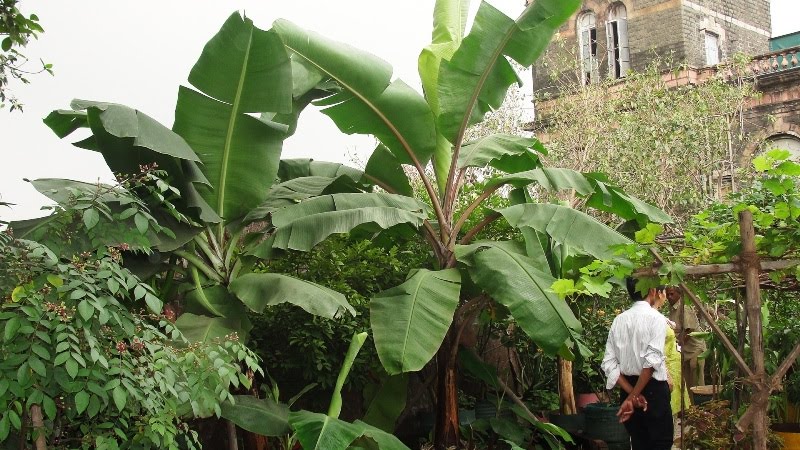
Generally the requirement in Amrut Mitti is 1 ltr/sq ft in 10 days. Also Plants with big leaves loose more water due to transpiration and hence need more water. Ex Banana. plants like pomegranate need very less water.
Quantity also depends on the
· Humidity
· Temperature
· Microclimate
· Height of land
· Quality of soil
Q. When should one water?
Water the plants preferably after sunset.
Q. Which part of the plant should be watered?
Plant should be watered at the active feeder root zone, always away from the stem.
Life Cycle of a Plant
Every plant goes through five stages in its life
Childhood
Puberty
Youth
Maturity
Old age
Each of these phases is of equal duration.
External intervention like pruning, adding ash etc… is most productive when administered at the appropriate phase of growth.
For eg: there is no use adding ash to plant when it is in its last stage of growth.
Plants are classified in three categories according to their life span
1. Short duration : 90 – 130 days
2. Medium duration : 1 – 3 years
3. Long duration or perennials
In case of seasonal or short duration plants proper growth at all stages becomes critical. For ex : if root growth is not optimum in the first 15 to 20 days no amount of external inputs will be effective.
Leaves and branches also show these stages in their life cycles
NOTE:
The life of banana is 13 months.
Divide 13 by 5 = 2.6
Say three months
First three months of banana plant are the childhood phase.
During this time no photosynthesis takes place, and no food is prepared by plant.
This period is to be deducted during calculation of weight of dry matter prepared by plant during its life cycle.
So we consider 10 months.
Dry Weight of plant
Dry weight is that weight that remains constant after drying in sun ie; if we were to consider fresh bio mass, the same is called ‘fresh weight”. Allow this to dry under sun. Weigh it on alternate days. In span of 5 to 7 days when no loss of weight will be observed; that is dry weight.
Q How is this knowledge applied in understanding or calculating the yield of crop?
A. Through experiments and analysis it is understood that plants prepare 3 gms of dry matter/sq ft area of canopy. Out of this
1 gm is utilized by the plant in metabolism activities.
1 gm is uitilised for building branches, roots, leaves etc…
1 gm is uitilised for making fruits
So if we measure the canopy area, we can calculate the dry matter prepared by plant, and thereafter calculate the expected yield.
This knowledge also helps us understand the need of development of a proper canopy, which in turn depends on proper root growth arising out of a nutrient rich live soil.